Últimas noticias

K&N Replacement Air Filter for Nissan and Infiniti SUVs is Designed to Boost Horsepower

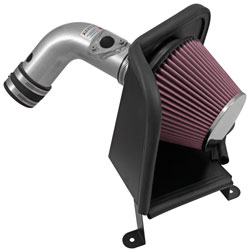
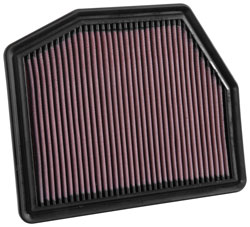
The K&N 33-5036 air filter is designed for 2014-2015 Nissan Pathfinders and Infiniti QX60.

The K&N 33-5036 air filter fits the 2014-2015 Nissan Pathfinders and Infiniti QX60

Introduced in 1985 to compete with the Chevrolet Blazer, Ford Bronco II, Jeep Cherokee, and Toyota 4Runner, the Nissan Pathfinder was a two-door front engine, rear-wheel and four-wheel drive SUV that shared styling and most components with the Nissan Hardbody Truck. To enhance its off-road capabilities, Nissan gave it the rear five link coil suspension found on the Nissan Safari.

In the vehicle’s fourth generation starting in 2012 and running to the present, its body style was changed to a 4-door crossover and its platform is shared with the Infiniti QX60, the Nissan Altima, Maxima, Murano, and Quest. This was the first model that abandoned the use of the rear door handles in the “C” pillar. In addition, the four-wheel drive model weighs considerably less than the previous models.

Introduced in 2012 and called the Infiniti JX until 2013, the Infiniti QX60 is a seven-passenger mid-size luxury front engine, four-wheel drive and front-wheel drive crossover SUV. It was introduced in the United States in 2013. It is Infiniti’s first three-row crossover.

Renamed the QX60 in 2014, the car received a number of upgrades including USB port added in the center console, 8-inch touchscreen and navigation with AroundView Monitor, Forward Braking System, Forward Collision Warning and Lane Departure Warning/Prevention Systems, rear view camera, Bose speakers and surround sound.

K&N is offering the 33-5036 replacement air filter for the 2014-2015 Nissan Pathfinder and Infiniti QX60. The filter is engineered to boost horsepower and acceleration and is washable and reusable.

It features a multilayered cotton gauze media that is specially treated with oil to make the strands of the cotton very sticky. The K&N air filter can be used for up to 50,000 miles before it needs to be cleaned, depending on driving conditions. If properly cleaned when it is supposed to be, the filter can be reused over and over again. This means that it will last for as long as you own your car. There is no need to ever replace it.

To clean your filter, K&N offers the 99-5000 filter care service kit that is formulated to cleanse and recharge the filter so that it can be reused.

K&N is so sure of the quality of the filter it backs it with a 10-Year/Million Mile Limited Warranty that guarantees that the filter will perform for up to 10 years or 1,000,000 miles without requiring replacement.

The K&N 33-5036 replacement air filter is designed to fit into the existing factory air box. It will not void the vehicle warranty and it works with OEM vehicle electronics. It can be installed in just minutes using conventional hand tools.

The K&N 33-5036 replacement air filter is designed to fit the following vehicles:

2015 NISSAN PATHFINDER 2.5L L4 Fuel Injection - All Models
2015 INFINITI QX60 2.5L L4 Fuel Injection - All Models
2014 NISSAN PATHFINDER 2.5L L4 Fuel Injection - All Models
2014 INFINITI QX60 2.5L L4 Fuel Injection - All Models

clear

K&N PRODUCT SEARCH     WHERE TO BUY K&N

A K&N Typhoon Air Intake Will Turn the Buick Verano Turbo into a Wicked Sleeper

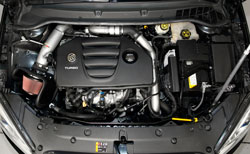
A K&N 69-4536TS Typhoon Intake boosts low-RPM torque on the Buick Verano Turbo

A K&N 69-4536TS Typhoon intake boosts low-RPM torque on the Buick Verano 2.0L Turbo

Most of the time, a car's "mission" is clearly defined. It's a sports sedan, a luxury car, an economy car, etc. The 2014-2016 Buick Verano Turbo on the other hand, is a compact car, a luxury car, and a hot rod all rolled into one. This pint-sized junior executive barn stormer gets its muscle from an intercooled twin-scroll turbocharged 2.0L 4-pot that cranks out an impressive 250-hp and 260 lb-ft of torque. Drop the hammer and 60 mph will appear in nearly the same time as most hot hatchbacks. Yet the ride in this little Buick won't beat you up on the drive to work, and all of the recycled denim sound insulation will turn your commute into a time of quiet contemplation. However, if you want to do more than just keep up with those Subaru WRX's and Volkswagen Golf GTi's, you can add a K&N 69-4536TS Typhoon performance air intake system. It's designed to eliminate airflow restrictions, which can increase power by an estimated 8.97 horsepower and 8.36 lb-ft of torque. All of that extra muscle will come in at lower RPM's too. So you can just sail right past all those brightly colored tuner cars, as you set a new lap time on your way to, uh, work.

The K&N 69-4536TS Typhoon Intake adds high-RPM horsepower on the Buick Verano Turbo

The K&N 69-4536TS cold air intake adds high-RPM horsepower on the Buick Verano Turbo

The secret to the 2014-2016 Buick Verano 2.0L Turbo is in the technology. Many high tech components are used in this engine, and they're all controlled by a sophisticated engine computer. One of the camshafts spins a pump that pressurizes the fuel system up to 2,250 psi at wide-open throttle. This causes the gas to exit the injectors in a fine mist, which helps it to blend more thoroughly with the air inside the cylinders. To maximize the benefits of this precisely controlled direct injection system, a twin-scroll turbocharger uses exhaust gases to turn a compressor that forces air into the cylinders at up to 20 psi. That air is drawn in through the air box and routed to the compressor, which sends it to an intercooler to lower the temperature before it reaches the cylinders. The pressurized air then mixes with the fuel mist to form a more potent fuel/air mixture prior to detonation. However, the stock air intake system is riddled with restrictions that can hamper airflow and elevate the air temperature, resulting in a reduction of the engine's power output.

Dyno chart for a 2014 Buick Verano 2.0L Turbo running a K&N 69-4536TS Typhoon Intake System

Dyno chart for a 2014 Buick Verano 2.0L Turbo running a K&N 69-4536TS cold air intake system

In order to improve the efficiency and power of a turbocharged engine, you have to increase the amount of air going into the turbo's compressor. Unfortunately, the components of the OE intake system on your Buick Verano 2.0L are designed to do just the opposite. For example, the factory air box only has a small hole for the air to enter, and the thick paper air filter stores dirt on the surface, which can severely limit the amount of air that can reach the engine. A K&N 69-4536TS cold air intake system on the other hand, utilizes an oversized conical K&N performance air filter that mounts in place of the stock air box. The increased surface area and high-flow cotton gauze filter media can significantly increase the volume of air entering the system. The filter's unique oil treated material is also designed to trap and store dirt deep inside its web of sticky cotton fibers, allowing unrestricted airflow for up to 100,000 miles before cleaning is required (depending on road conditions).

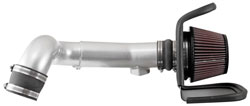
A K&N 69-4536TS Typhoon Air Intake installed on a 2014 Buick Verano 2.0L Turbo

A K&N 69-4536TS Typhoon air intake system installed on a 2014 Buick Verano 2.0L Turbo

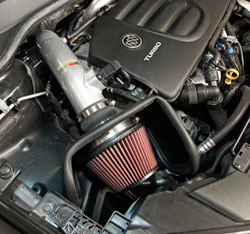
To prevent warm engine bay air from getting sucked into this oversized air collector, a powder-coated heat shield is placed around the filter, and a rubber top gasket seals against the underside of the hood when it's closed. Once the K&N air filter has removed up to 99% of the airborne contaminants, the clean air then travels to the turbo through a silver powdercoated aluminum intake tube. This wide-diameter K&N intake tube is much larger than the stock tube, and all of the wide-angle bends are formed with a mandrel machine to reduce power robbing air turbulence. That allows the Buick 2.0L intercooler to create a much colder air charge, which translates into more low-RPM torque, and much faster throttle response. In fact, this kit made an estimater increase of almost 9 horsepower and 8 lb-ft of torque. The intake tube also has special fittings for the factory mass airflow sensor and crankcase vent tube, meaning you won't have to make any underhood or ECU programming modifications.

The K&N 69-4536TS is designed to fit the following vehicles:

2016 BUICK VERANO 2.0L L4 Fuel Injection - All Models
2015 BUICK VERANO 2.0L L4 Fuel Injection - All Models
2014 BUICK VERANO 2.0L L4 Fuel Injection - All Models

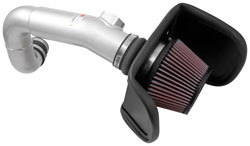
Closeup of a K&N 69-4536TS Typhoon Intake for the 2014-2016 Buick Verano 2.0L Turbo

Closeup of a K&N 69-4536TS intake for the 2014-2016 Buick Verano 2.0L Turbo

clear

K&N PRODUCT SEARCH     WHERE TO BUY K&N

Cory Texter Off to a Busy Start to the Flat Track Racing Season

After a winter spent in training, bike preparation, and anxiously awaiting the new racing season, K&N-sponsored flat track racer Cory Texter is back in the saddle. The 2017 season has started with a flurry of warm-up, regional, and specialty races, as well as the first round of the American Pro Flat Track series. Here is a rundown of Texter’s early season racing.

Savannah All-Star Half Mile

Texter on his Kawasaki 750 in the Expert Twins class in the 2017 Pro Flat Track season

Texter will pilot his Kawasaki 750 in the Expert Twins class in the 2017 Pro Flat Track season

The Georgia event is really a glimpse at how the off-season went for the racers. Texter calls the Savannah All-Star Half Mile the “unofficial kick-off event for the year” and one of his favorite tracks. The short, wide, well-groomed course proved to be a successful first act for Texter’s 2017 season.

“A lot of fast guys come to this race and I was eager to see where I stacked up after a long off-season,” Texter said. “I felt good all day on both my Kawasaki 750 and Honda 450.”

The Super Singles class is open to any size engine as long as it is a single cylinder machine. Texter rode his Honda in the class. “I didn't get the best start, but I passed a couple guys and chased down the leader who was riding a super fast big bore 450,” said Texter. “I was close, but no cigar and finished 2nd.”

The Expert Twins class main event proved to be another fast-and-furious contest with the results more to Texter’s liking. “I pulled the holeshot and put in some solid laps the first half of the race.” said Texter. “When I saw I had a large gap over the rest of the field, I put it on cruise control and sailed her home for the win. I have won a couple of races here in the fall, but this was the first spring All-Star main event I have won here.”

Volusia All-Star Half Mile

Cory Texter in the pits in the Daytona TT

The early season is all about sorting out bike set up and preparing for the season ahead

Next up in the early season racing schedule for Texter was the All-Star Half Mile at Volusia Speedway Park in Barberville, Florida. “I typically do well at this track, so I was looking forward to competing,” said Texter. “I rode the same classes as Savannah, Super Singles and Expert Twins.”

“This track is extremely tough to pass on and a good start is crucial,” Texter said. “Unfortunately, in the Expert Twins heat race, I had a terrible jump and found myself in third place. I was trying all I could to make a pass for second, but the bike wasn't working the way I wanted it to. I ended up getting passed on the last lap and finished 4th in my heat race.”

Getting a similar start in the Super Singles race, Texter’s competitive nature kicked in to full gear. “In the Super Singles class, I again got a terrible start, but I wasn't going to be denied twice, so I ended up [passing] five riders in my heat race to take the win,” said Texter.

“We made some changes to my Kawasaki Twin and I was really eager to redeem myself in the main event, but Mother Nature decided she wanted it to rain and we were scored by the heat races,” Texter said. “I ended up 7th on the twin, but I had the fastest heat race time on the 450 and won the Super Singles class. I was bummed with the final result on the twin and not being able to try the changes we made to the bike for the main event, but it felt good to get a win on my 450.”

American Flat Track Series Round 1 - Daytona TT

Texter walking on the track at the Daytona TT

Texter was frustrated that a shift lever led to a Daytona DNF

With the warm-up and shake-down races under his belt, the first round of the American Pro Flat Track Series in Daytona, Florida was Texter’s next stop. The Daytona TT is part of the Daytona Bike Week festivities.

“I have never been to a race in my life where there were more unknowns than the Daytona TT,” said Texter. “I prepared myself and my bikes as best I could with the budget I had, but I still wasn't sure what to expect. The track was basic, but fast and technical. To be honest, I have only raced a couple of TT events over the past few years. I ride a lot of motocross, but it's still a different animal. I qualified 21st, which I wasn't pleased with.”

There is a new knockout format to the qualifying in American Pro Flat Track this year, and Texter made the cut with a gutsy qualifying ride. “I battled hard and finished in 8th, which was good enough for a transfer to the main,” Texter said. “I train hard and I was really looking forward to a hard, long 25 laps.”

For Texter, the Daytona TT was clear and powerful evidence that the smallest mechanical part can be the difference between a successful race effort and a DNF.

“One of the biggest issues I was having all day was with my shifter. My bike was missing shifts all night long,” said Texter. “After the semi, we noticed my shifter was loose, so we swapped in a new shifter. Unfortunately on lap five in the main event, my shifter came off completely causing me to DNF.”

“I was credited with 17th,” Texter said. “I was bummed about the whole deal because I was confident I could have had a solid finish, but a mechanical like that is out of my control, so it's something I can't dwell on. We learned a lot of things that will better us for the additional TT races on the schedule. On the positive, I kept it on two wheels and came out of there with a couple of points heading into a couple of race tracks I am really excited for.”

Clash of the Concrete Indoor Race

Texter on the podium of the Clash of the Concrete Indoor race

Texter's Daytona week ended on a high note with a concrete oval win at Daytona Bike Week

Wrapping up the whirlwind start of the flat track season for Texter was an indoor race in downtown Daytona Beach sponsored by Harley-Davidson® and IV League Flat Track. It would prove to be a very positive race for Texter.

“I was tired from the National the night before, but racing motorcycles is my job, so I got my bike ready and went to work,” Texter said. “There were some good riders in attendance with a good purse on the line. Harley-Davidson broadcasted the whole event on their Facebook page, which was pretty neat. I do well on these concrete indoors. I ended up winning my heat race and the main event. Although it wasn't a Grand National, it felt good to redeem myself from the night before and grab another win for my sponsors during Daytona Bike Week.”

Texter is primed and ready for round two of the American Pro Flat Track season. The Georgia Short Track will be held at Dixie Speedway in Woodstock, Georgia. “Thanks to all of my sponsors for all of the support this season,” Texter said. “I know that is a cliché statement, but without all of the support, I wouldn't be able to call this my job and I am truly blessed to have a great group of supporters behind me this year.”

clear

K&N PRODUCT SEARCH     WHERE TO BUY K&N

Filtro de aire K&N para 2016 Honda Civic está diseñado para impulsar los caballos de fuerza

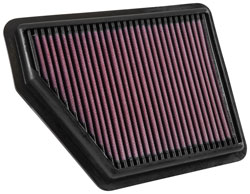
The K&N 33-5045 replacement air filter is designed to fit into the factory air box

The K&N 33-5045 replacement air filter is designed to fit into the factory air box

El Honda Civic se introdujo en el mercado en 1972 y originalmente fue clasificado como subcompacto. En un principio estuvo disponible como vehículo de dos puertas. Sin embargo, más tarde ese mismo año se lanzó una variante hatchback de tres puertas. Posteriormente se añadieron un hatchback de 5 puertas y un station wagon de cinco puertas.

El Civic original funcionaba con un motor enfriado por agua de 1.169 cc (71.3 in³), y también tenía frenos de disco delanteros, asientos deportivos en vinil reclinables y simulación de tapicería de madera en el tablero de instrumentos.

El lanzamiento del primer Civic ocurrió justo antes de la crisis petrolera de 1973, cuando los consumidores exigían un vehículo de bajo consumo de combustible. Adicionalmente, el motor funcionaba tanto con gasolina plomada como con la que no contiene plomo, y el sistema CVCC del motor no requería de un convertidor catalítico. Sin embargo, el automóvil cumplió con los estándares de emisiones de la Agencia de Protección Ambiental de 1975 para hidrocarburos y monóxido de carbono. La combinación de todos estos convirtió al Civic en un auto muy popular poco después de haber ingresado al mercado.

2El 2015 marcó el comienzo de la décima generación del Civic. El modelo del 2016 fue presentado a finales de octubre del 2015 e incluyó una serie de variantes, entre las que se encuentran los modelos sedan, coupe, hatchback de 5 puertas, Si trims y Type-R.

El automóvil es impulsado por dos motores I4–- un motor atmosférico DOHC de 2.0-litros que se combina con ya sea una transmisión manual de 6 velocidades o una transmisión variable continua (CVT); y el motor DOHC turboalimentado con inyección directa de combustible y capacidad de 1.5-litros que viene con una transmisión CVT. El motor de 2.0-litros que se combina con la transmisión CVT logra un estimado de economía de combustible de la EPA de 31-mpg en la ciudad, 41-mpg en carretera y 35-mpg en combinación.

K&N ofrece el filtro de aire de reemplazo 33-5045 que fue pensado y diseñado específicamente para el Honda Civic 2016 con el motor de 2.0 litros. El filtro es lavable y reutilizable, y durará hasta 50.000 millas antes de que sea necesario limpiarlo, dependiendo de las condiciones de conducción.

El filtro posee un medio que se conforma de cuatro capas de gasa de algodón, la cual fue tratada con un filtro de aceite de grado especial que hace que las fibras de algodón se tornen pegajosas para que puedan capturar y retener los contaminantes.

El filtro de aire 33-5045 viene pre-lubricado y listo para instalarse en la caja

El filtro de aire 33-5045 viene pre-lubricado y listo para instalarse en la caja

Los filtros de aire K&N han sido diseñados para superar tanto a los filtros que están hechos de papel desechable como a los de espuma. Para cumplir con los estándares mínimos de filtrado, los filtros de aire de papel deben ser gruesos y/o las fibras deben estar fuertemente comprimidas y ser densas. Sin embargo, esto hace que el flujo de aire sea más restrictivo. Adicionalmente, cuando el filtro de papel se atasca de contaminantes, cae la presión que hay dentro, pero la presión atmosférica de aire de fuera del filtro no cambia. Cuando la diferencia de presión se hace demasiado grande, las partículas de suciedad que capturó el filtro de papel son forzadas a pasar a través del medio de papel, disminuyendo de esta forma su capacidad para proteger el motor. Es por esto que un filtro de aire de papel convencional debe ser reemplazado cada 10.000 millas.

Los filtros de aire de espuma tienen una superficie más pequeña que restringe el flujo de aire y la capacidad de retener la suciedad. Las celdas abiertas de la espuma permiten que pasen los contaminantes. A medida que se ensucia el filtro, las presiones de vacío de mayor intensidad distorsionan las celdas, forzando que la suciedad llegue más profundamente en el filtro, y eventualmente en el motor.

Las partículas de suciedad que captura el filtro de aire K&N tienen poco efecto en el flujo de aire durante la vida útil del filtro. En vez de eso, las capas entrelazadas de las fibras de algodón son pegajosas porque están lubricadas con aceite; de esta forma capturan las partículas y las mantienen en suspensión. El aceite empapa las partículas y las convierte en parte de los medios de filtrado. A medida que se acumulan los desechos, el flujo de aire elevado continúa pasando alrededor de las partículas de suciedad que están atrapadas en la superficie del algodón.

K&N también ofrece limpiadores de filtros de aire que han sido especialmente formulados para limpiar el filtro. Esto le permite que siga reutilizando el filtro siempre y cuando lo limpie adecuadamente después de cada 50.000 millas, dependiendo de las condiciones de conducción. Esto significa que el filtro de reemplazo lavable y reutilizable de K&N puede ser el último filtro que jamás tendrá que comprar.

K&N tiene tanta seguridad en sus filtros de aire, que los respalda con una garantía limitada de 10-años/millón de millas. K&N le promete que el filtro de aire funcionará hasta por 10 años o 1,000,000 de millas sin que tenga que ser reemplazado.

El filtro de aire de reemplazo K&N 33-5045 ha sido diseñado para las siguientes aplicaciones del vehículo:

2017 HONDA CIVIC 2.0L L4 Fuel Injection – Todos los Modelos
2016 HONDA CIVIC 2.0L L4 Fuel Injection – Todos los Modelos

clear

BÚSQUEDA DE PRODUCTO K&N     DÓNDE COMPRAR K&N

LS-Based 16 Cylinder Engine Takes Marine World By Storm; Will Show Cars Be Next?

XVI didn't want to add length to the engine so modified the K&N filter to house the throttle

K&N filters are mounted inside custom covers on both ends of the motor

If a cast aluminum 854 cubic inch V16 engine based on the Chevrolet LS architecture seems like an extreme way to generate big horsepower, you need to take a look at the work of the engineers at XVI Power in Detroit, Michigan.

Initially designed for powerboat applications, the crew at XVI Power said that they’d love to see the engine mounted in a few street rods or custom cars. Despite the fact that the engine has four more cylinders, it’s only a foot longer than a Viper V10

The concept behind the motor is that as high-end boat V8 engines are beginning to reach 1,600 horsepower, they’ve become near-race motors with all the maintenance and durability issues related to developing over 200 horsepower per cylinder. And while race teams understand and plan for the kind of abuse a race engine sees, boat owners, perhaps a tad unrealistically, expect these heavily-tweaked motors to provide reliable, long-term service.

The alternative, as XVI Power saw it, was to reduce the load on any single cylinder by increasing the total number of cylinders. Therefore, a cylinder that was expected to produce the stressful 200 horsepower now delivers a more rational 100 horsepower per cylinder, according to XVI team member, Tom Robinson.

XVI wanted to use as many LS components as posible, to make repairs and upgrades easy

The V16 engine in all its glory, the LS design basis is clear even from this view

The XVI Power team chose the Chevrolet LS architecture as the basis, and Caleb Thomas designed and developed a single cylinder block for all 16 cylinders. The A356-T6 aluminum block is cast and machined by a firm in the Detroit area that does a great deal of prototype work for the auto industry so the quality is high. One variation for the LS engines is that the dry sump oil and two-stage water distribution begins and ends at the center of the block for more even distribution. This was a lesson learned by Thomas when he was program manager on the Cadillac V16 show car of 2003.

That gap in the cylinder bore allows for the use of Chevrolet LS cylinder heads, from mild to wild, at the owner’s discretion. In fact, many parts come directly from the LS design, with the only major parts coming from XVI Power being the engine block, crankshaft (supported by ten main caps machined into the oil pan and using big block bearings), the oil pan itself, and the gun-drilled single piece camshaft. Duramax bearings are an option for supercharged or turbo applications. Valves, lifters, rockers, manifolds, many fittings, gaskets, and seals, are all standard Chevrolet items so when any maintenance is required, the parts are close by the marine repair shop.

Here you can get a good view of the piping on the water-cooled headers

Here you can get a good view of the piping on the water-cooled headers

Despite the perception of the V16 being a large engine, a great deal of attention has been focused on making it as compact as possible. All drive ancillaries are kept tucked tight, as are the exhaust manifolds. Even the heat exchangers are low and tight to the block and the throttle bodies have been tucked inside modified K&N E-3514 filters to make sure the induction package didn’t extend past the ancillaries. The mounting hardware is the same as used for a big block. In essence, the installation of the XVI engine is about the same width and length as a Chevy big block-based motor.

Performance is staggering. The basic engine runs with the ignition firing every 45 degree, making for a very smooth running engine regardless of output. And that range of output starts at the basic 900 horsepower and moves up through to a 1,400 horsepower model, all normally-aspirated. Forced induction will be offered latter with a 1,600 horsepower supercharged version and 2,000 horsepower with a quad turbocharger setup. We can’t wait to see the first show car with an XVI engine.

clear

K&N PRODUCT SEARCH     WHERE TO BUY K&N