Dernières Nouvelles

Racing Takes Center Stage at Sturgis Motorcycle Rally in South Dakota

RSD Super Hooligan racing series action at the Buffalo Chip in Sturgis, South Dakota

K&N is a major sponsor of the RSD Super Hooligan racing series

The very first motorcycle rally in Sturgis, South Dakota had racing at its core. In 1938, the Jackpine Gypsies motorcycle club staged he "Black Hills Classic" which revolved around a race featuring 9 competitors. The racing blossomed in those early years to include track racing, drags, and hillclimbs. While racing, at times, has taken a backseat to other forms of entertainment in the history of the rally, the 77th Sturgis Rally returned to its competitive roots.

This year’s Sturgis Rally featured RSD Super Hooligan, American Flat Track, AMA Supermoto, street drags, and vintage racing. Rally crowds enthusiastically celebrated the heightened focus on speed and competition. The estimated 376,000 rally attendees were treated to some form of high-octane racing on virtually every day of the rally.

RSD Super Hooligan Racing

Roland Sands and his Super Hooligan Indian Scout at the Buffalo Chip in Sturgis, South Dakota

Roland Sands, the driving force behind Super Hooligan racing, with his Indian Scout build

The K&N-sponsored RSD Super Hooligan series is a true throwback to the early days of motorcycle racing. Just like the Jackpine Gypsies of the 1930s, the modern hooligans race moderately modified street machines on a challenging dirt course. This year’s Sturgis Rally featured raucous handlebar-to-handlebar action at the famous Buffalo Chip Campground.

The racing action did not disappoint the enthusiastic fans that lined the challenging TT-style dirt track. In the end, the elder statesmen of the Super Hooligan series, Joe Kopp and Brad Spencer, finished first and second in the Main.

The competition was made even more exciting with the fact that two custom built Indian Scout Sixty motorcycles were given away after the racing action. One of the Indians was built by good friend of K&N and series organizer, Roland Sands, and the other by Carey Hart of RCH Racing.

American Flat Track

Sammy Halbert racing in American Flat Track at the Buffalo Chip in Sturgis, South Dakota

Sammy Halbert showed incredible determination in the American Flat Track TT in Sturgis

The inaugural Buffalo Chip TT was a huge success. A massive crowd watched the nation’s best flat track racers battle on the unique and challenging TT course. The track, which featured a jump as well as a tight hairpin and several unique right hand turns, tested the stamina and skill of the professional racers.

K&N-sponsored rider Brad Baker was excited about the race as he looked over the track before the event.

“This is going to be a challenging track – no doubt about it,” Baker told K&N. “It’ll be tough to pass, so a good start will be especially important.”

Pointing to the track’s hairpin, Baker said, “That turn...that’s going to make for some excitement.” He was prophetic as the ultra-tight turn was the scene of several spectacular crashes and lots of traded paint.

A jump at the American Flat Track race at the Buffalo Chip in Sturgis, South Dakota

The flat trackers caught air on the TT course's jump

The racing was fast and furious and packed with intrigue. In one of the most dramatic moments of the day, K&N-sponsored Sammy Halbert suffered a mechanical issue while leading on the last turn of his qualifying heat race. He desperately pushed his Estenson Logistics Yamaha FZ-07 down the final straight secure the final spot in the Main.

In the end, Briar Bauman raced his Ninja 650 to the win, with Indian’s Jared Mees finishing second. The podium was rounded out with Harley-Davidson’s Jake Johnson who finished third. Making the most of his Herculean qualifying effort, Halbert fought through the field from his last position start to finish an impressive 4th.

Buffalo Chip Street Drags

Street Drag action at the Buffalo Chip in Sturgis, South Dakota

The street drag action at the Buffalo Chip kept the large crowd entertained

In the true “run what you brung” tradition, the Buffalo Chip hosted an invitational street drag through the middle of the venue’s amphitheater area. Two-by-two, competitors raced their high-dollar street machines on the dusty asphalt quarter-mile strip.

Wheelies, fishtails, and burning rubber delighted the fans that lined the strip and crowded the elevated viewing areas. Harley baggers, vintage Japanese standards, and other street bikes in a rainbow of styles fought for rally bragging rights.

AMA Supermoto

The hybrid form of motorcycle racing that combines dirt and street racing rounded out the entertaining Moto Stampede at the Buffalo Chip. It was impressive how the grounds crew at the Chip carried out the metamorphosis of the amphitheater to accommodate the various track configurations.

Patrick Simmons of the Doobie Brothers sings the National Anthem at the Spirit of Sturgis Races

Patrick Simmons of the Doobie Brothers sings the National Anthem at the Spirit of Sturgis Races

Defending AMA Supermoto Champion Gage McAllister won the overall at the Sturgis event.

Spirit of Sturgis Vintage Races

With a noble mission to keep the history of Black Hills racing alive, the Spirit of Sturgis Vintage Motorcycle Festival graced the historic downtown Sturgis park. The Sturgis Half Mile paid homage to the antique board track racers from the 1920s, hand shift racers from the 1930s - 1950s, and the vintage big twins from the '60s and '70s.

The uber-enthusiastic event organizer and vintage racer, Brittney Olsen, is the driving force in keeping the event alive and thriving.

The vintage race bikes at the Spirit of Sturgis races ready for the start

The vintage race bikes at the Spirit of Sturgis races ready for the start

“We had a safe and fun event with an intimate but enthusiastic crowd,” Olsen told K&N. “It is just so important to keep the history of Sturgis racing alive. That’s what we are trying to do.”

The main event of the Spirit of Sturgis was kicked off with a few fast and fun laps by a vintage board track racer, followed by Patrick Simmons of the Doobie Brothers delivering a rousing rendition of the National Anthem. The final event gave the gathered race fans a rumbling, shaking, and thoroughly entertaining glimpse into what racing looked like in the early years of the Sturgis Rally.

K&N is proud to be a vital part of the Sturgis Motorcycle Rally and the resurgence of the vibrant Black Hills race scene.

The race track at the Buffalo Chip in Sturgis, South Dakota

The Buffalo Chip staff kept busy modifying the race track for various events

Brittney Olsen on her vintage race bike in Sturgis, South Dakota

Brittney Olsen (left) is on a mission to preserve vintage racing in Sturgis

clear

K&N PRODUCT SEARCH     WHERE TO BUY K&N

Le filtre à air pour la Toyota MIRAI et la C-HR est conçu pour augmenter la puissance du véhicule.

2017 Toyota C-HR

La Toyota C-HR 2017 mélange l’allure d’un coupé et celle d’un SUV

La Toyota C-HR (pour Coupe-High Rider), est en fait un crossover avec des fenêtres plus étroites, une ligne de toit basse, une vitre arrière surélevée, des montants centraux noirs et une courroie haute.

La voiture est construite sur une plate-forme avec un faible centre de gravité. La rigidité structurale est renforcée avec des soudures par points supplémentaires, des goussets, des entretoises et des adhésifs sur des zones spécifiques, ce qui aide à la prise en main. L'avant du véhicule comporte des amortisseurs Sachs et une grande barre stabilisatrice avant, ainsi qu’une nouvelle suspension à double triangulation avec des chocs Sachs et des supports supérieurs en uréthane apparaissent à l'arrière.

Trois moteurs peuvent alimenter ce véhicule.

• Un moteur à turbocompresseur de 1,2 litre (1197 cc) qui produit 114 chevaux de chevaux (85 kW) à 5200 tours/minute et un couple de 140 pieds/livre (150 N-m) à 1500 tour/minute.

• Un moteur DOHC à 16 soupapes de 2,0 litres (1,987 cc) qui offre 155 chevaux de puissance (158 PS / 116 kW) à 6200 tours/minute et un couple de 144 pieds/livre (195 N-m) à 4400 tours/minute.

• Une variation de moteur à cycle d’Atkinson de 1,8 litre (1798 CC) qui génère un couple de 98 chevaux (73 kW) et 153 pieds/livre (207 N-m) et comprend un moteur électrique qui produit jusqu'à 121 chevaux.

La Toyota Mirai est une berline de taille moyenne à 4 portes avec un moteur avant, et le premier véhicule à pile à hydrogène combustible à être commercialisé. Le lot de piles à hydrogène combustible produit une puissance maximale de 153 chevaux (114 kW). L'efficacité de la génération d'électricité est améliorée grâce à l'utilisation des premiers canaux de flux en maille 3D disposés dans un cadre tridimensionnel qui aide à améliorer la dispersion de l'air, permettant une production uniforme d'électricité sur les surfaces des piles. La configuration permet une taille plus compacte et une densité de sortie de puissance 2,2 fois supérieure à celle du modèle de location limitée FCHV-advanced de Toyota. Chaque lot comprend 370 cellules d'empilage à une seule ligne et chaque cellule mesure 1,34 mm d'épaisseur et pèse 102 grammes. Le lot de piles à combustible offre environ 160 fois plus d'énergie que les piles à combustible résidentielles actuellement en vente au Japon et comprend un nouveau convertisseur compact de 13 litres à haute efficacité et haute capacité pour augmenter la tension jusqu’à 650 volts.

La voiture dispose de deux réservoirs d'hydrogène au poids combiné de 87,5 kg, avec une structure à trois couches en plastique renforcé de fibre de carbone, avec du nylon 6 et d'autres matériaux.
La 2017 Toyota Mirai

La Toyota Mirai est alimenté par une pile à hydrogène combustible

La voiture est vendue au Japon, aux États-Unis, au Royaume-Uni, au Danemark, en Allemagne, en Belgique et en Norvège.

La Mirai a remporté le prix 2016 de la voiture verte (écologique) de l’année.

Le filtre à air de panneau de remplacement 33-3080 de K&N est conçu pour s'adapter à la Toyota MIRAI et la Toyota C-HR. Il est lavable et réutilisable et est conçu pour augmenter la puissance et l'accélération. Il dure jusqu'à 80 000 kilomètres avant le nettoyage (en fonction des conditions de conduite).

Le filtre à air comprend un support en coton multicouche traité avec une huile spéciale qui lui permet de capturer et de contenir les contaminants. Le filtre K&N suit trois principes de la physique du flux d'air : l'interception, l'impact et la diffusion.

Le principe de l'interception concerne les particules de saleté qui s'écoulent dans un flux d'air. Le flux d'air prend toujours le chemin le plus court et est obligé de circuler autour des fibres du filtre. Certaines particules entrent en contact avec les côtés des fibres et l'adhésivité de l'huile les contient.

L'impact concerne les particules de saleté plus grandes ou plus lourdes. L'inertie ou l'élan des particules les fait s'écarter du trajet du flux et se heurter aux fibres du milieu qui les capturent.

Le principe de la diffusion traite des lois de la physique qui régissent le mouvement de très petites particules de saleté. Les petites particules sont fortement influencées par les forces dans le flux d'air comme les changements de vitesse et de pression, les turbulences dues à d'autres particules et l’interaction avec des molécules d'air. Ces variables font que de très petites particules se déplacent de manière aléatoire et chaotique. Elles ne suivent pas le flux d'air, mais leurs mouvement chaotiques les font entrer en collision avec les fibres du filtre, permettant au filtre de capturer des particules beaucoup plus petites que les ouvertures du milieu.

Le filtre à air K&N avec de la gaze de coton traité avec de l'huile fonctionne mieux que les filtres à air en papier conventionnels. Les filtres à air en papier doivent être épais et/ou bien comprimés et denses pour répondre aux normes minimales de filtration. Par conséquent, les filtres à air en papier qui offrent une filtration adéquate sont plus restrictifs pour le flux d'air. De plus, au fur et à mesure que le filtre à papier s’obstrue, la pression dans le filtre diminue tandis que la pression atmosphérique à l'extérieur du filtre reste la même. Le différentiel excessif à haute pression peut entraîner la poussée des particules de saleté à travers le support papier. Alors que le flux d'air pousse le filtre, sa capacité à protéger le moteur diminue considérablement jusqu'à la fin ce qu’il soit changé.
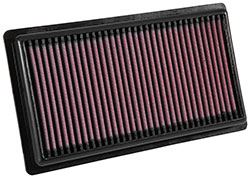
Le filtre à air 3080 de K&N comprend un support de gaze en coton multicouche traité avec de l’huile.

Le filtre à air du panneau de remplacement 33-3080 de K&N est conçu pour augmenter la puissance et l'accélération.

C'est pourquoi le filtre à air K&N lavable et réutilisable fonctionne sur 80 000 kilomètres entre les nettoyages (selon les conditions de conduite). K&N propose également le kit d’entretien de filtre 99-5000 spécialement conçu pour nettoyer le filtre à air afin qu'il puisse être utilisé à plusieurs reprises tant que vous possédez votre voiture.

K&N est tellement sûr de la qualité de ses filtres à air qu'il les couvre avec une garantie limitée sur 10 ans et 1,6 millions de kilomètres. Nos produits dureront aussi longtemps que votre voiture durera, sans nécessiter de remplacement!

Le filtre à air K&N avec le milieu en gaze de coton traitée à l’huile surpasse également les filtres à air en mousse ordinaires.

Les filtres en mousse manque de surface, ce qui gêne le flux d'air et la capacité à contenir la saleté. En outre, la saleté s'accumule à l'extérieur des ouvertures de blocage du filtre en mousse. Cela provoque des pressions de vide plus élevées qui faussent les cellules et attirent la saleté dans le filtre. Le débit d'air diminue lorsque les cellules sont bloquées et l'air filtré est turbulent.

Le filtre à air de remplacement 33-3080 est conçu pour les véhicules suivants:

2018 TOYOTA C-HR 1.2L L4 injection de carburant - Tous les modèles
2017 TOYOTA MIRAI Hydrogène - Tous les modèles
2017 TOYOTA C-HR 1.2L L4 injection de carburant - Tous les modèles
2016 TOYOTA MIRAI Hydrogène - Tous les modèles
2016 TOYOTA C-HR 1.2L L4 injection de carburant - Tous les modèles

clear

RECHERCHE DE PRODUITS K&N     OÙ ACHETER DES PRODUITS K&N

Un filtre à air de cabine K&N aidera les conducteurs de camions à respirer plus facilement

Le pollen, la poussière et les bactéries sont tous piégés par un filtre à air de cabine efficace

Sur le plan du confort du conducteur, l'air respiuré devrait être une priorité au même titre que d'autres facteurs

Bien que le va et vient des conducteurs ne soit pas le même problème qu’il y a quelques années, les flottes intelligentes savent qu'il est important que leurs conducteurs soient heureux. Parmi les facteurs importants cités par les détenteurs d’un permis de conduire commercial pour déterminéer s’il sont satisfaits de leur flotte actuelle, le confort a une grande importance. On comprend, étant donné les horaires de conduite, jusqu'à 11 heures par jour, qu'un siège de conducteur confortable constitue une attente raisonnable. Et avec leurs huit heures quotidiennes passées sur couchette, les conducteurs préfèrent que celle-ci soit large, confortable et équipée avec toutes les commodités.

Un élément qui a un impact important sur le confort du conducteur est la qualité de l'air qu'il respire. L'entrée d’un air non-filtré dans la cabine influence de manière significative l'apparition d’irritation aux yeux, aux nez et à la gorge, ainsi que de maladies respiratoires, d’allergies et des symptômes d'asthme. L'air non filtré peut transporter des allergènes, des poussières, des moisissures, des champignons, des spores, des bactéries et des particules dans la cabine.

La solution a été que les fabricants de camions installent des filtres à air de cabine remplaçables dans le système CVC des véhicules qu'ils vendent. Le filtre est conçu pour capturer ces particulues irritantes minuscules tout en alimentant le conducteur en air frais.

Comme pour tout filtre à air, l'efficacité du filtre à air de la cabine dépend de deux facteurs : premièrement, sa capacité à filtrer l’air entrant en capturant ces particules et d'autre part son débit.

Les filtres à air de cabine K&N fonctionnent sur 10 ans (ou plus) ou 1,6 millions de kilomètres

Un filtre à air de cabine élimine les particules qui peuvent nuire au conducteur

Le filtre à air de cabine VF8001 de K&N qui remplace les numéros de pièces 22446600 et 22446600 et les ABPN83328345 et N8328345 de Alliance atteint ou dépasse la capacité de filtration et de dépoussiérage du filtre d'origine, en particulier sur le long terme.

Le filtre VF8001 de K&N est constitué d'un milieu synthétique non-tissé et collé thermiquement entre deux grilles de protection peintes à la poudre. Le milieu est pris en sandwich entre un cadre en polyuréthane moulé avec précision qui s’insère parfaitement dans votre camion.

Beaucoup de filtres OEM utilisent le papier comme support, ce qui “charge en surface” rapidement, obstrue les pores du filtre à l'extérieur et ne permet pas l'accès de l'air. Le milieu synthétique non tissé est prétraité avec une formule spéciale afin que les fibres saisissent et maintiennent les particules de saleté et de poussière lorsqu'elles pénètrent dans le filtre.

Pour fonctionner efficacement, un filtre à air de cabine doit être remplacé ou rafraîchi selon les recommandations du fabricant. Sinon, il sera vite bouché. Les conséquence d’un manque d’entretien du filtre à air de la cabine peuvent être sévères. Le système CVC doit travailler beaucoup plus intensément pour attirer l'air dans le filtre sale (comme une paille pincée), ce qui peut raccourcir drastiquement la durée de vie des composants du système. Et avec un filtre en papier ordinaire qui s’obstrue rapidement, celle-ci sera encore plus courte.

Enlever et remplacer le filtre à air de cabine doit être un travail rapide et facile

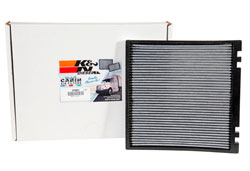
Tout le nécessaire pour installer un nouveau filtre VF8001 de K&N dans un Freightliner adapté est inclus dans la boîte

Avec un filtre à air de cabine VF8001 de K&N, l'intervalle entre deux entretiens passe à 12 mois ou 19 000 kilomètres et, surtout, le filtre n'est pas éliminé et remplacé. Les filtres à air de cabine de K&N sont conçus pour être nettoyés et réutilisés pour de nombreux cycles. La garantie limitée de K&N vous couvre sur 10 ans et 1,6 millions de kilomètres.

À des intervalles d'environ 12 mois ou 19 000 kilomètres, à l'aide d'un kit de nettoyage de filtre à air de cabine 99-6000 de K&N , vous ou vos techniciens peuvent facilement renouveler et ré-huiler le filtre à air de cabine, ce qui le ramène à un état quasi neuf et apte à protéger la cabine du camion et son chauffeur.

Pour trouver des mises à niveau K&N supplémentaires pour les voitures, les camions, les 4x4, les scooters, les motos, les motomarines, les camping-cars, et presque tout ce qui brûle du carburant, utilisez la fonction de recherche K&N par véhicule. Trouvez un concessionnaire K&N agréé à proximité en utilisant la recherche de revendeur K&N.

clear

RECHERCHE DE PRODUITS K&N     OÙ ACHETER DES PRODUITS K&N

American Success Story: Hank Robinson Engraves Another Show Truck for 2017 SEMA

Hank Robinson of Hanro Studios engraves his latest show truck for the 2017 SEMA Show

Hank Robinson of Hanro Studios engraves his latest show truck for the 2017 SEMA Show

Back in 1776, the founding fathers signed the Declaration of Independence to ensure that all Americans could live in a land of opportunity. Millions have fought and died to protect the fundamental freedoms that many of us take for granted. But a retired Army Staff Sergeant named Hank Robinson decided to pay tribute to the fallen heroes of the modern era when he engraved the entire aluminum body of a 2016 Ford F-150 show truck called Freedom Blues.

Over a 10 year span, Hank Robinson was deployed in the war zones of Afghanistan and Iraq. When he retired in 2011, he found that transitioning back into civilian life wasn't as simple as most people would think. One day you're fighting insurgents on a rooftop. And the next, you're fighting for a parking spot outside a Wendy's. Turning off Survival Mode isn't easy for many veterans unless they can figure out a way to channel their focus into the present and future. This is why Hank decided to use the G.I. Bill to attend welding school, where he wound up trying his hand at metal engraving. He enjoyed it so much that he began engraving one-of-a-kind gifts for family and friends, and eventually started Hanro Studios out of his garage.

The Hanro Freedom Blues Ford F-150 on display at the 2016 SEMA Show

The Hanro Freedom Blues Ford F-150 on display at the 2016 SEMA Show

The Freedom Blues Ford F-150 was intended to bring a message of hope to veterans that were struggling with the same issue. It was prominently featured at the 2016 SEMA Show in Las Vegas, and Hank even did live engraving sessions during the show to complete the artwork. The truck was then displayed at over a dozen shows, including the Goodguys All-American Sunday in Scottsdale, and it led a procession of bikes on a Ride for the Fallen.

“Lots of vets came to see it at shows. The overall vibe that I got was nothing less than positive. Even on all the social media channels, I got like one hater. Which is pretty unique in this day and age.” Hank went on to explain, “A lot of veterans have said, 'Hey man I need to find a different outlet, maybe not engraving, but something to help transition back.' It's pretty cool that the art would give them the motivation to do something other than what they're doing.”

Freedom Blues featured a K&N 77-2591KP intake engraved with an American flag

Freedom Blues featured a K&N 77-2591KP intake engraved with an American flag

After an extensive tour on the show circuit, the Hanro Studios Freedom Blues F-150 was featured on the cover of Truckin’ magazine, and it garnered the attention of West Coast Customs owner Ryan Friedlinghaus, who invited Hank out to LA to do some engraving work on a Cadillac they were building for legendary rock star Kid Rock. Turns out the Coupe DeVille was originally owned by country music legend Waylon Jennings. WCC and Kid Rock wanted to rebuild the car as a tribute to Jennings, and the custom engraving work turned out to be the perfect finishing touch.

Robinson was doing an engraving demonstration at a show in Atlanta when Inside West Coast Customs did the reveal at Kid Rock’s home in Tennessee. “Ah that sucks,” Robinson said when he found out that he couldn't make the reveal. But he went on to say, “It was awesome. Everybody at West Coast showed nothing but respect. I had an amazing time.”

The Hanro Aluminati show truck is based on a 2017 Ford F-250 Super Duty

The Hanro Aluminati show truck is based on a 2017 Ford F-250 Super Duty

As far as the Freedom Blues show truck, it will be auctioned off in January 2018, at the famous Barrett Jackson Scottsdale auction. A portion of the proceeds will go to a fantastic organization called The Warrior Built Foundation, which provides veterans with the tools and training they need to explore a new life in the automotive and fabrication world. And to replace his now-famous show truck, Hank is building an all-new truck for the 2017 SEMA Show called “Aluminati”.

The Aluminati show truck will need approx 1100 hours of engraving - by Leap of Faith Photography

The Aluminati show truck will need approx 1,100 hours of engraving (Leap of Faith Photography)

The Hanro Studios Aluminati show truck is based on a 2017 Ford F-250 Super Duty, and the name was chosen from several hundred social media submissions (it’s a play on words since the 2017 Ford Super Duty now has an all aluminum body). Hank purchased both show trucks himself, so this one will become his personal “mobile engraving station” once the car show season is over. In the back, it will have an onboard air, vacuum, and power supply system that was designed and built by Truck Vault. The overall concept and artwork were created by Robinson, and ECD Customs. Chris Payne from Truck Guru created the renderings and is acting as project manager for the build.

Among its many modifications, the Hanro Aluminati will have an engraved lift kit from McGaughys Suspension, engraved rims from American Force Wheels, and they’ll be wrapped in equally imposing rubber from Interco Tires. Of course, the bumpers and grille will be completely engraved, and the LED exterior lighting will probably be visible from the International Space Station. Under the hood, the new 6.7L Powerstroke Diesel engine will get a K&N 63-2597 intake, which will naturally receive his artistic touch. Hank said, “There’s no doubt K&N is going on this truck, and I’m excited to see what they can do for the new Super Duty.”

The Hanro Aluminati show truck will be on display at the 2017 SEMA Show in Las Vegas

The Hanro Aluminati show truck will be on display at the 2017 SEMA Show in Las Vegas

Since this will eventually be Robinson’s “work truck”, the interior will be all about luxury. Scottsdale Upholstery is installing black Roadwire leather seats, and Roadwire even provided enough extra leather to wrap the doors, dash, and console. On the outside, Troy Buck of FX Autobody laid down the slick black/silver color scheme. And Hank will spend an estimated 1,100 hours with his Dremel tool, carving multiple Hanro Studios themed designs into the body.

When he’s not traveling to give live engraving demonstrations or working on other projects, Hank has been working sunup to sundown to complete this build on time. “My wife, Christine, is my best support structure. She works full-time, she’s a part-time real estate agent, she takes care of our three kids full-time, and she still finds time to bring me breakfast, lunch, and dinner at the shop. Without her, I couldn't do any of this.”

We at K&N would like to thank Mrs. Robinson for helping her husband’s vision become reality. If you would like to check out the result of all their hard work, stop by the Truck Hero booth (# 61040) at the 2017 SEMA Show in Las Vegas.

Hank Robinson will show off his metal engraving skills on his latest 2017 SEMA Show truck

Hank Robinson will show off his metal engraving skills on his latest 2017 SEMA Show truck

Une Volkswagen Golf gagne 8 chevaux de puissance avec le système d’entrée d’air K&N Typhoon série 69

The Volkswagen Golf has been a bestseller in Europe for two decades, but in the United States it has a wide range of compacts as competition. Think of it as a descendant of the car that started the economy box trend years ago, the Volkswagen Rabbit.

Air Intake 69-9752 for the 1998 to 2001 Volkswagen Golf
Air Intake 69-9752TP for the 1998 to 2001 Volkswagen Golf

Air Intake 69-9752 for the 1998 to 2001 Volkswagen Golf
Air Intake 69-9752TB for the 1998 to 2001 Volkswagen Golf
If you own a 1998, 1999, 2000 or 2001 Volkswagen Golf with a 2.0L engine you know the standard four-cylinder engine is good for 115 horsepower. K&N Engineering has released a new 69-Series Typhoon Air Intake System.

K&N tests have shown an 8 horsepower gain @ 6000 RPM for this intake.  "The position of the mass air sensor and the type and position of the filter used are very critical for power gains," said K&N Project Designer Joost Adriaans. "We did a lot of testing with all these variables."

There are two eye catching choices for this 69-Series Intake System. Consumers have a choice of polished aluminum or powder coated blue. The polished aluminum finish on this 69-Series Intake System is part number 69-9752TP. For the powder coated blue the part number is 69-9752TB. Blue is a very popular color on the Volkswagen Golf in Europe.

No matter your color preference K&N Engineers have made sure the design on the system provides maximum power to meet consumer demands. "The intake system is quite long and it makes it harder to develop due to alignment issues," said Adriaans. "But we were able to take advantage of the vehicle's design with this kit by positioning the filter far away from the engine. Modifying one of the grill inserts provides extra air to the filter."

The filters on our Air Intake Kits are washable and reusable. It takes about 90 minutes or less to install this kit.  Find K&N products for your vehicle using the K&N application search then use the K&N dealer search to find a K&N dealer in your part of the world.