Dernières Nouvelles

Increase the Output of your 2016 Camaro SS by Nearly 25 HP with a Cold Air Intake

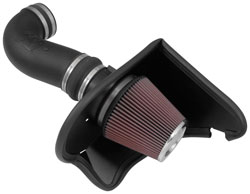
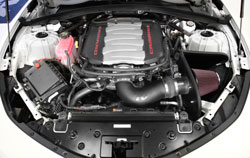
K&N 63-3092 intake system for 2016 Chevrolet Camaro

Cold air intake enters an oversized K&N high-flow air filter protected by a heat shield

Introduced in the seventh-generation Corvette Stingray, the LT1 6.2L opened the next chapter in the long, historic legacy of the small-block engine that stretches back to the mid-1950s and it gives the 2016 Camaro SS an outstanding balance of performance and efficiency.

The LT1 is architecturally similar to the LS family of small-block engines, but with a unique block casting, cylinder head design, oiling system, an 11.5:1 compression ratio and more. It also incorporates advanced technologies such as direct fuel Injection and continuously variable valve timing.

To draw an adequate volume of air an entirely new intake manifold design was developed, which provides a straighter path into the combustion chamber. With as much time and development effort that GM engineers put into the LT1, one would assume that they didn’t leave any opportunities to improve performance on the table. But they did. There’s an additional way to improve the performance of your 2016 Camaro SS: the K&N 63-3092 AirCharger air intake system, which has been chassis dyno-tested proven to deliver an estimated 24.46 horsepower gain at the rear wheels over an otherwise stock 2016 Camaro SS.

The K&N 63-3092 AirCharger air intake system replaces the restrictive factory air filter and air intake housing on the 2016 Camaro SS. K&N AirChargers significantly improve incoming air flow as well as reduce turbulence in the intake tube. Air is then directed through an aerodynamically-verified intake tube into the engine’s throttle body. The intake tube includes a fitting for the factory mass air sensor and crank case vent hose.

The air intake first enters K&N high-flow air filter seated within a heat shield that installs into the original air box space. Much of the performance increase can be attributed to the oversized conical air filter manufactured from multiple layers of oiled cotton filter media which offers less resistance than traditional filters. The multi-layered cotton filter material also filters out microparticles that could damage your engine, so as to ensure a long engine life. Each design is verified through K&N’s in-house filtration testing lab, which adheres to ISO 5011 standards, ensuring that your K&N filter provides high airflow without putting engine protection at risk.

K&N 63-3092 intake system installed on 2016 Chevrolet Camaro

The K&N AirCharger Intake System can be installed in 90 minutes or less with simple hand tools

Best of all, the K&N AirCharger Intake System can be installed in 90 minutes or less with simple hand tools. All tools required are listed in the clear, step-by-step photo-illustrated instructions specific to your car that come included in the package.

And once you’ve installed your K&N filter you’ve eliminated the need to buy another air filter for the life of your covered 2016 Camaro SS. The only maintenance is a service you can do yourself in no time at all. At intervals of 100,000 miles (depending upon your driving conditions) use the K&N recharger kit 99-5000 clean and refresh your AirCharger air filter, preparing it for another 100,000 miles of driving. The K&N air filter you purchase is designed to last for the lifetime of your vehicle, which K&N guarantees will perform for up to 10 years or 1,000,000 miles without requiring replacement.

The K&N 63-3092 fits the following vehicles:

2016 CHEVROLET CAMARO SS 6.2L V8 Fuel Injection - All Models

clear

K&N PRODUCT SEARCH     WHERE TO BUY K&N

Roland Sands Designs Custom Pays Tribute to Indian Motorcycle Racing Heritage

Roland Sands Designs Indian Scout and rider

The RSD custom Scout is a rolling tribute to Indian's racing heritage

Indian Motorcycle’s racing roots trace back to the very beginning of the sport in the early 1900s. Indians were a constant fixture on the infamous board tracks of the turn of the century as well as the dirt ovals of the early flat tracks. You can’t talk motorcycle racing heritage without a reverent acknowledgement of Indian’s integral role in starting and growing the sport.

Likewise, the talented folks at Roland Sands Designs have always had close ties with flat track racing. It’s common to see an RSD custom on display in the pits of the nation’s biggest flat track races. In fact, RSD custom motorcycles even roost the flat track oval at events like the 2016 Super Hooligan Race in Las Vegas.

Roland Sands Designs Indian Scout right view

The Scout breathes through a K&N high flow air filter

It’s only fitting that the venerable marquee and Roland Sands would enter into a mutually beneficial partnership as Indian reenters the flat track scene. It’s a symbiotic match made in racing heaven.

The most recent fruit of the RSD / Indian relationship is the scintillating Sands custom that pays homage to the early Indian race machines. “This was a fun build,” says Sands, “and we put our best foot forward in hopes to pay proper homage to the original Scouts that tore up race tracks all over the USA from the 1920s through the 1950s.”

The RSD project began with the newest incarnation of the Indian Scout. The mating of the new technology of the modern Indian company and the vintage styling cues of the Roland Sands concept is remarkable. That seamless visage is the result of an artistic vision, intricate design, and masterful craftsmanship.

Roland Sands Designs Indian Scout left view

The styling is vintage and the technology is modern

The most striking design element of the RSD build may well be the girder fork which is wonderfully reminiscent of the Indians of the first half of the 20th century. It was crafted from scratch from chromoly steel, and a mountain bike shock was fitted to offer a bit of dampening. Making a liquid-cooled bike look vintage is no easy task, but the RSD team did a fine job of creating radiators and plumbing that offer up a clean look. Then there is the issue of what to do with the modern electronics. To solve that quandary, Sands constructed a faux oil bag to hide the wiring and computer technology.

Of course, the beautiful Indian breathes through a K&N filter that supplies the V-twin with the healthy dose of clean air it needs. It’s fitting that an American icon like the Indian is fitted with a legendary filter made in the USA. On the exhaust end, RSD created a custom stainless system that is capped off with one of their Track mufflers.

Roland Sands Designs Indian Scout seat

Classic details abound on the Indian custom

The project is coated in a stunning vintage Indian red paint job. The pin stripping, lettering, and numbering were applied with had turned gold leaf. The gold accents are carried into the shock reservoirs and the chain for a beautifully unified motif. The vintage aesthetic is completed with antiqued leather grips and tooled leather solo seat.

So the goal of the Roland Sands Designs custom was to “pay proper homage” to the Indian motorcycles that defined the incipient stages of the sport, and the passion of motorcycle racing. All we can say is - mission complete!

clear

K&N PRODUCT SEARCH     WHERE TO BUY K&N

Stealthy 700 Horsepower 1961 Oldsmobile F-85 To Break Cover At SEMA In K&N Booth

Rendering of the Greening-built custom 1961 Oldsmobile F-85

The original rendering presented to Jimmy Jackson by Greening Auto Company

You’ll find little argument here that the best of car builders are artists of the highest order. But unlike painters, who start with a blank canvas, car builders are more like sculptors, who have to work within the constraints of the marble. As Michelangelo famously said, “every block of stone has a statue inside it and it is the task of the sculptor to discover it.” It’s with that thought in mind that we take a first look at the 1961 Oldsmobile F-85, being carved out of metal by builder Jesse Greening of the Greening Auto Company and will make its world debut at the SEMA Show, K&N Booth 22755.

A few years back when Jesse was picking up a car to be rebuilt for another customer, he spotted the F-85 nearby, faded and pretty well stripped out. Like a sculptor examining a block of marble, Jesse could envision how the Olds could be transformed. So he brought it home as well, locking it away in a storage building until he had the time to start work on the Olds.

Rendering of the interior of the Greening-built custom 1961 Oldsmobile F-85

The interior of the Olds F-85 as envisioned by M&M Hot Rod Interiors

Years passed until Jesse’s good customer Jimmy Jackson was poking around the shop grounds looking for something interesting for their next project. When he stumbled across the Oldsmobile it was love at first sight. Further it would make a great complement to Jimmy’s 1968 Camaro, which Jesse had also built.

The scope of the build was agreed-upon and artist’s renderings of the completed car were presented. Jimmy greenlighted the program and Jesse was off and running, and like most artists, happy that the Olds build had found a patron.

1961 Oldsmobile F-85 with floor removed readied for the reassembly process

The Oldsmobile body with the floor cut out, awaiting the Roadster Shop chassis

The car was brought into the shop and stripped bare. Any cases of tin worm were dealt with and fresh metal welded in place. The floor was cut out of the unibody as the Olds would soon ride on a Roadster Shop chassis and a new floor and rear wheel tubs were fabricated in-shop. And not only would it carry the Roadster Shop’s front suspension, but also its independent rear suspension as well. The folks at the Roadster Shop explain that the geometry of the IRS is designed to work with the larger, heavier vehicles, but also as an optimized system with its independent front suspension. This provides optimal geometry from front to back and the best vehicle handling dynamics for the application.

Power will be generated by a 700 horsepower LS7 Black Label engine from Mast Motorsports. Black Label refers to products developed in-house by Mast. The build starts with a fully-machined aluminum block that’s topped off with Mast LS7 305cc cylinder heads. The hand-built LS7 based engine utilizes a Mast Motorsports-developed camshaft with a strong lope that creates great mid and high RPM power for the kind of street manners required of a daily driver but still can be used in competition, if you’re so inclined.

The stripped Oldsmobile body shell test-fitted to the new chassis from Roadster Shop

The Olds body dropped onto the Roadster Shop chassis - a perfect fit the first time

Topping off the engine is a Harrop Hurricane ITB manifold from Australia. It has eight separate long, straight ports, positioned horizontally, with a smooth transition to the inlet port to increase flow efficiency. It’s capped off by a carbon fiber cover that hides all the wires and hoses. Feeding air into the Harrop Hurricane is an inlet in the hood fabricated to accept two K&N panel air filters. So when you lift the hood, all you see is motor. But with the hood down, a rubber gasket provides a tight seal so cold outside air is directed through the K&N filters and into the inlets.

Power is driven back through a GM 4L80E four-speed automatic transmission upgraded from stem to stern for an increased torque capacity by Bowler Performance Transmissions. While well-known as a durable and responsive transmission for Chevrolet and GMC light truck applications, the 4L80E has also been used by high-dollar brands like Aston Martin, Bentley, Jaguar, and Rolls-Royce. Stopping this beast is left to the experts at Baer Brakes, who are suppling a package that consists of 14 inch rotors and six piston calipers all around.

Custom wheels created at Greening Automotive for the Oldsmobile F-85

Wheels designed and machined in-house at Greening feature a subtle stripe of orange

Other suppliers to the project are first-class companies including an Ididit Steering column, Lokar throttle components, Classic Instruments, and Vintage Air air conditioning. M&M Hot Rod Interiors will handle the upholstery.

Wheels were designed and machined in-house, and if you look carefully, you’ll notice that one spoke has a thin stripe of orange paint – a color that matches the orange exterior of the ’68 Camaro that Jesse built for Jimmy. And when completed, the car will be painted in stunning black, with a subtle stripe of that same orange. If you'll be in Las Vegas for the 2016 SEMA show, this will be one that you won't want to miss. It will be located in the K&N Filters booth, #22755.

clear

K&N PRODUCT SEARCH     WHERE TO BUY K&N

Rookie Driver Riley Herbst Looking for First Win in K&N Pro Series West

NASCAR, K&N Pro Series West, Riley Herbst, Bill McAnally Racing

Riley Herbst has seven top-five finishes in 13 NASCAR K&N Pro Series West races.

Riley Herbst’s first season in the NASCAR K&N Pro Series West is winding down. He is one of the top rookie drivers in the series. It’s quite a different path than the one his father and grandfather took in the world of motorsports. Herbst comes from a racing family, but the Herbsts were known for off-road racing and the Baja 1000 before NASCAR.

“I just wanted to try something different,” Herbst said. “I wanted to try to make a career out of stock car racing. They were very surprised, but they are very supportive.”

Herbst is third in the NASCAR K&N Pro Series West rookie standings with one race to go. The season ends at All-American Speedway in Roseville, California, the home track for his team, Bill McAnally Racing. Herbst put together a string of top-five finishes late in the season. He snapped that streak with a 19th-place finish at Meridian Speedway in Idaho in September. But he said his team showed great improvement in the second half of the season.

“I feel like in the beginning of the year we were a little bit behind the goals,” Herbst said. “From Iowa on, we started to click. I set my goals at top fives and top threes each and every week. We were starting to hit it. We just got some bad luck in Meridian. But I feel like we can end on a good note in Roseville.”

Herbst finished in the top five in more than half of the NASCAR K&N Pro Series West races. He has seven top fives in 13 races. He posted a couple of podium finishes at Douglas County Speedway in Oregon and Evergreen Speedway in Washington.

“That was a pretty hard race,” Herbst said about the race at Douglas County where he finished third. “It reminded me a little like Meridian. We could never catch a good caution that would put us on the inside. When we were in third with three to go, we were really hoping for a caution to come up with a win there.”

Riley Herbst interview with NBCSN after race

Riley Herbst is third in the NASCAR K&N Pro Series West rookies standings after 13 races.

He was also third at the race in Evergreen, where the Bill McAnally Racing team swept the top three spots in the race. Todd Gilliland won the pole and the race.

“We just had a good car,” Herbst said. “I feel like BMR was the class of the field that day. I was just happy to get a 1-2-3 finish.”

Herbst continued his streak of top fives during the doubleheader weekend at the Utah Motorsports Campus road course event in September. He was fourth in the first race and fifth in the second race.

“I am very comfortable on the road courses,” Herbst said. “I knew that if we stayed on the track, we would be right up there in contention. We were leading laps in the second race. We just needed the race to be a little bit shorter. I think we would have been able to come out of there with a win.”

The NASCAR K&N Pro Series West race at Meridian Speedway proved challenging for Herbst. He was collected in a couple of crashes and was knocked out of contention early in the race. There were 13 cautions for 92 laps in the NAPA Auto Parts/Idaho 208.

“We were running strong. We were top of the board in practice,” Herbst said about the race at Meridan. “We were just riding in third and somebody took us out in the first 30 laps. We worked our way all the way back up into the top five and then we got wrecked again which put us out of the race.

NASCAR K&N Pro Series driver Riley Herbst in car

Riley Herbst is sixth in the NASCAR K&N Pro Series West standings after 13 races.

“It seemed everybody was on different pages and racing a little bit crazy.”

With one race remaining in the K&N Pro Series West schedule, Herbst is sixth in the series standings. He is looking to end the season on a high note.

“We were just hitting on all cylinders, not all cylinders, but we were doing good and we were just hitting our stride,” Herbst said. “We had a little hiccup in Meridian. I felt like we were going to add to our stride a little bit longer.

“I wish we were higher than that, but we had a couple of instances, like in Meridian. Orange Show really killed us. We only got like five laps in at Orange Show. That really hurt us in points.”

On the verge of completing his first season in the NASCAR K&N Pro Series West, Herbst said he is grateful for the opportunities K&N has provided.

“It’s huge to have K&N on board to support our young NASCAR careers,” Herbst said. “Without them, I don’t think this series would be around. They are substantial to everything. They let us race, which is the most important part of it. They sponsor our series to let us go out and do what we love.”

clear

K&N PRODUCT SEARCH     WHERE TO BUY K&N

Les filtres à air pour habitacle K&N nettoient et rafraîchissent l'air entrant

Le laboratoire de filtration interne de K&N

Le laboratoire de filtration d’air interne de K&N mesure l’efficacité du filtre selon les normes internationales rigoureuses ISO / TS 11155

Conduire votre voiture, camion ou SUV pourrait littéralement vous rendre malade. Dans votre véhicule se glissent chaque jour des milliers de passagers indésirables tels que les bactéries, la poussière, le pollen et d’autres allergènes, ainsi que les matières particulaires, tout cela pourrait déclencher une réaction allergique ou affecter votre santé à long terme. Pour vous protéger et protéger vos passagers de ces terreurs en miniatures, K&N a développé une gamme de filtres à air de cabine conçus pour surpasser les filtres à air de cabine standard en papier.

La Saab a été la première société qui à développé un filtre à air de cabine pour ses voitures, suivie peu après par la BMW et d'autres fabricants européens tel que l’Audi. Les constructeurs automobiles européens ont été les premiers à adopter largement les filtres à air de cabine, même dans les voitures à bas prix comme la Seat et la Volkswagen. En fait, il est presque impossible d'acheter une voiture en Europe aujourd'hui qui ne soit pas équipée d'un filtre à air de cabine.

La Mazda a été la première des marques japonaises à offrir des filtres à air de cabine, mais les autres fabricants les ont rapidement adoptés. Actuellement, la Toyota installe des filtres à air de cabine dans le 100% de ses nouvelles voitures.

Les constructeurs automobiles Américains, liés avec de plus grandes lancements à l'époque, ont décalé d’adopter les filtres à air de cabine, même si la recherche à l'époque a montré que le 84% des consommateurs Américains interrogés préféreraient que leur nouveau véhicule était équipé d'un filtre dans la cabine. Les premiers filtres à air de cabine sont apparus dans les voitures Américaines de l'année 1997 dans les modèles Buick Century et Régal, ainsi que la Chevrolet Monte Carlo.

Filtre à air de cabine de remplacement K&N lavable

Tout ce dont vous avez besoin pour remplacer votre vieux filtre à air de cabine avec une version permanente de filtre de K&N est inclus dans la boîte

À ce stade, il est difficile de trouver un nouveau véhicule dans le lot d'un concessionnaire qui ne soit pas équipé d'un filtre à air de cabine. Et même des véhicules qui ne possèdent pas un filtre de cabine ont souvent les outils de support en place; alors, ajouter un filtre peut être une tâche simple.

Tandis qu’un filtre à air de cabine installé dans notre voiture, camion, ou SUV est bénéfique à la plupart d'entre nous, il est essentiel pour les personnes souffrant d'allergies. Considérez l’ordinaire ambroisie. Seulement une poignée de spores microscopiques de la plante prolifique peut déclencher une attaque dans une victime d'allergie lorsqu’elle serait assise dans une voiture fermée.

Les filtres à air de cabine de K&N ont été spécialement conçus pour aider à capturer les particules nocives et dangereuses dans l’air telles que les spores, le pollen, le mildiou, les moisissures, les champignons et les germes. Ils sont également chargés électro statiquement afin qu'ils saisissent et tiennent la saleté et la poussière sur le passage. En fait, les filtres à air de cabine de K&N sont conformes à la norme internationale rigoureuse ISO / TS 11155 pour les filtres à air de cabine tel que confirmé par le propre laboratoire de filtration de l'air de la compagnie.

Les fabricants varient dans leurs intervalles de remplacement du filtre à air de cabine, et beaucoup d’entre eux font l'appel pour un intervalle uniforme de rechange de 12.000 miles. Certains des types les plus rigoureux affirment qu'il est préférable de changer le filtre deux fois par an, à la fin de l'hiver et à la fin de l'été.

Alors, quels sont les risques de ne pas changer le filtre aussi souvent que recommandé, ou même de retirer le filtre complètement? Nous ne recommandons certainement pas ni l’un ni l’autre, et pour une bonne raison.

Les filtres à air de cabine K&N nettoie l'air qui entre dans le véhicule

Un filtre de cabine de K&N élimine les contaminants du flux d'air entrant dans votre véhicule qui peuvent affecter votre santé à court et à long terme

Tout d'abord, s’il n’y a pas une source à écoulement libre de l'air entrant, votre unité de climatisation doit travailler beaucoup plus, ce qui pourrait raccourcir sa durée de fonctionnement. Et aucun filtre ne permet des quantités illimitées de spores, de pollen, de bactéries, de particules ou d’autres saletés de l'extérieur du véhicule, dans l'intérieur du véhicule.

Et si vous pensez que ces confinements vont tout simplement sauter directement à travers votre véhicule, considérez ceci: une étude Finlandaise a constaté que les grains de pollen ont été trouvés dans de plus grandes quantités sur les tableaux de bord des voitures d'essai que sur les tablettes arrière. Les chercheurs ont écrit que "Ces résultats inattendus pourraient être expliqués en partie par la fixation rapide et efficace du pollen sur les surfaces intérieures". Donc, le pollen ne s’envole pas sur tout votre véhicule, il se fixe sur la première surface avec laquelle il entre en contact. Là où vous et votre passager avant sont assis.

Donc, il n'y a pas moyen de contourner cela. Pour la santé de vos passagers ainsi que la votre, il est parfaitement logique de garder opérationnel un filtre à air de cabine propre dans le système CVC (chauffage, ventilation, climatisation) de votre véhicule.

Et si la pensée est d'acheter un filtre de 20 à 40 euros deux fois par an et de payer l'installation en plus, cela vous concerne, alors envisagez un filtre lavable, réutilisable d’air de cabine de K&N.


filtre à air de cabine sale

Un filtre sale et encrassé peut surcharger votre système de conditionnement de l'air ainsi que créer une situation où les confinements entrent dans votre véhicule à travers de petits trous

Les filtres à air de cabine de K&N sont fabriqués en un support filtrant synthétique non tissé délimité thermiquement, similaire à celui utilisé en tant que filtres de CVC dans les hôpitaux et d’autres établissements de santé. Son support en uréthane moulé est conçu pour être un remplacement serré et sécurisé du filtre de cabine d'origine de votre voiture, car il a été essayé encastré sur différents véhicules de la même année, marque et modèle.

Mieux encore, le filtre à air de cabine de K&N est conçu pour remplacer le filtre à air de cabine en stock de votre véhicule avec une version de filtre lavable et réutilisable qui est destiné à être nettoyé et réutilisé maintes et maintes fois. Donc ces filtres sont si durables qu'ils viennent avec une garantie limitée de 10 ans / 100 000 miles.

Alors que la plupart des nouvelles voitures, VUS et camions légers sont équipés d'un filtre à air de cabine, certains modèles plus anciens ne l’ont pas. Pour déterminer si votre véhicule est équipé d'un filtre à air de cabine, consultez le manuel du propriétaire. Les filtres de cabine sont généralement situés dans l'un des trois endroits: sous le capot près du pare-brise, sous le tableau de bord, ou derrière la boîte à gants. Pour déterminer si votre voiture est équipée d'un de ces filtres, vérifiez sur la cabine à la recherche du filtre à air de K&N.

La plupart des filtres à air de cabine peuvent être remplacées sans outils. Cependant, certains véhicules ont besoin d'un outil de base ou deux pour ouvrir le compartiment du filtre. Une fois qu’un filtre à air de cabine de K&N a été installé, vous avez à peu près éliminé la nécessité d'acheter et de remplacer les filtres à air de cabine traditionnels pour la vie de votre véhicule, avec la Garantie de K&N de 10 ans - 100,000 Miles.

l'installation d'un filtre à air de cabine lavable remplacement K&N

Dans de nombreux cas, remplacer le filtre à air de cabine est aussi simple que l'ouverture d'une porte, en tirant sur le vieux filtre et coulissant un nouveau filtre à air de cabine de K&N

Le seul entretien nécessaire est un service que vous pouvez faire vous-même en peu de temps. Vous devez nettoyer votre filtre à air de cabine de K&N aux intervalles recommandés de 12.000 miles (ou moins, si vous conduisez sur des routes poussiéreuses ou dans des zones avec grand nombre de pollen). Pour en faire une opération simple et facile, utilisez le kit de soins de nettoyage de K&N pour filtre à air de cabine. Le kit de nettoyage est livré avec deux bouteilles: l'une est une pompe de pulvérisation de 12 onces de nettoyant de filtre de cabine, qui non seulement desserre la saleté de la route de votre filtre mais supprime aussi les attrapés de la moisissure, les champignons, les allergènes, les bactéries et d’autres débris du filtre. Le deuxième flacon est une pompe en spray rafraîchissant du filtre d'air de cabine de 8 onces, ce qui ravive les propriétés électrostatiques du filtre à air de cabine, rechargez le filtre de sorte qu'il puisse arracher les particules de poussière et de saleté sur le flux d'air.

Sur la base de 50 ans d'archives et des échantillons principaux qui remontent à l'Âge de Pierre, des chercheurs Néerlandais ont conclu que «les changements climatiques mondiaux auront probablement une incidence sur l'intensité de la saison pollinique" dus à l'augmentation du dioxyde de carbone dans l'atmosphère. Donc, si vous avez remarqué une plus grande présence de pollen pendant la dernière année ou deux, il est prévu que cela fasse partie d'une tendance continue. Donc, les constructeurs automobiles sont clairement sur la bonne voie en installant des filtres à air de cabine dans leurs véhicules. Et vous pouvez mieux prendre soin de vous-même et de vos passagers en commandant aujourd'hui un filtre à air de cabine de K&N pour votre voiture, camion ou SUV.

Pour trouver d’améliorations supplémentaires de K&N pour les voitures, camions, semi-remorques, karts, scooters, motos, camping-cars, ou presque tout avec un moteur, utilisez la recherche d’outil de véhicule de K&N. Vous pouvez aussi trouver un revendeur agréé de K&N à proximité en utilisant l'outil de recherche de revendeur de K&N.

clear

RECHERCHE DE PRODUITS K&N OÙ ACHETER K&N

clear