
Intake Heat Soak Showdown: K&N versus OE
- 10 ott 2025

Heat soak can be a performance killer under the hood. We get asked about it all the time: What is it? How does it happen? Can K&N intakes help?
Thankfully, managing heat soak is something we design around from the start. So we decided to hit the road and demonstrate what happens in a real-world scenario – comparing two different types of vehicles with a K&N intake system versus the stock setup. Come along with us and let us show you how it really works where it matters most.

What is Heat Soak and Why Does it Matter?
Before we get into the testing, time for science class. Heat soak describes the process by which an internal combustion engine creates heat as a natural byproduct of the explosive action inside the engine. This heat permeates the engine bay and increases the temperatures of all components under the hood – including the air around those components. That air is a key component in the combustion process as it takes roughly 14 times as much air as fuel to create effective fuel consumption. Cooler air is more dense than warm air and allows for more powerful combustion, so as the air being pulled into the engine heats up, it creates less power in the engine. This is the key concern for the heat soak critics out there as they are always looking for ways to increase power and prevent losses.
The point in the conversation that K&N gets involved is how an aftermarket intake handles heat soak compared to the stock setup. There has been a lot of internal testing done over the years, but this test is about sharing the results and talking through the key takeaways with all of you readers.
Real-World Testing
From our past testing, we have a lot of data around heat soak and intake inlet temperatures. Even though we think we’re pretty smart, we really wanted to get into the science of this, so we brought in someone way smarter than all of us to be part of our testing. Bisi Ezerioha, thermodynamics expert and host of Motor Mythbusters was nice enough to lend us his expertise to dissect some of the data from our testing and validate what we have seen historically.

Bisi explained that heat soak can be affected by a huge number of variables including:
- Engine Type
- Vehicle Style
- Internal Engine Components
- Fuel Being Used
- Atmospheric Conditions
- Humidity
- Ambient Temperature
- Intake Design
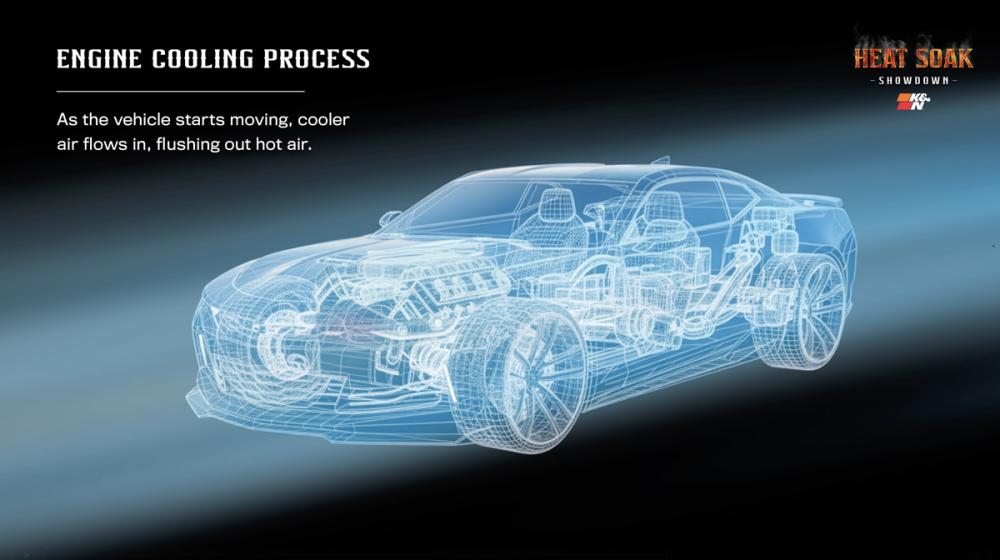
Despite all these variables, one has shown to be more important than any of the others – driving conditions. When any vehicle is sitting still idling, the engine creates heat and has nowhere to go other than to sit in the engine bay and heat everything up. However, once the car starts moving, outside air is introduced and starts flowing through the engine bay, clearing out that hot air and replacing it with cooler outside air. That key process is the focus of the testing for today.
In order to see the results across some different vehicles, we used two very different platforms for our testing – a 2024 Toyota Tacoma with a 2.4 liter inline 4-cylinder engine and a 2019 Chevy Camaro with the big 6.2 liter V8. This variety will show how different types of engines and vehicles compare and if they follow similar patterns from one to the next.
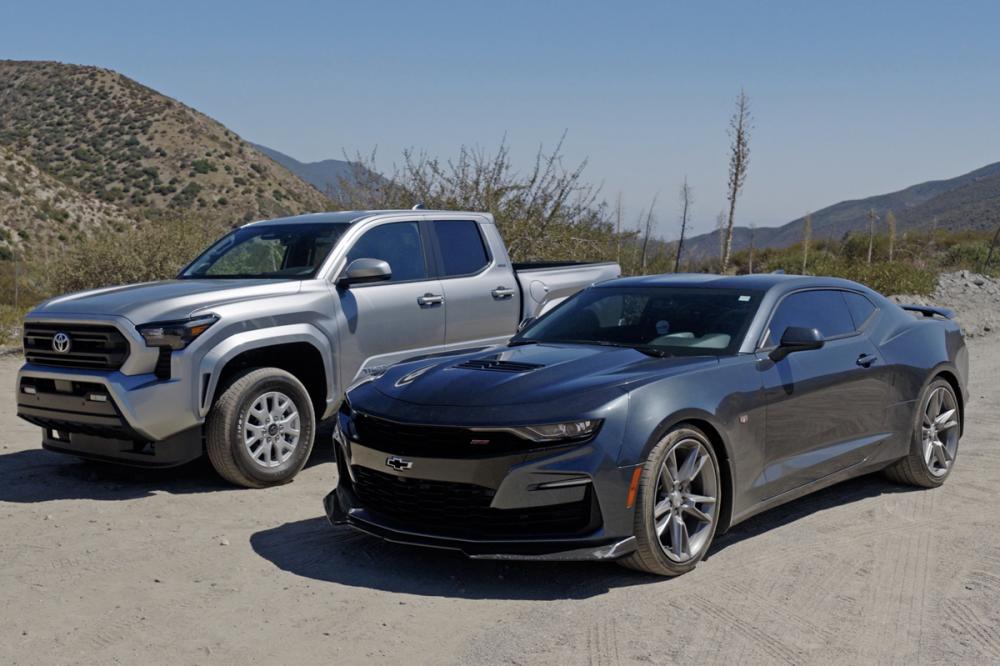
Additionally, to make sure these tests are done right, we came out to the California desert in the middle of summer to really get the temperatures up and put our vehicles through a grueling test. With ambient temperatures pushing triple digits the entire day, we were sure to see some significant heat soak on both test vehicles.
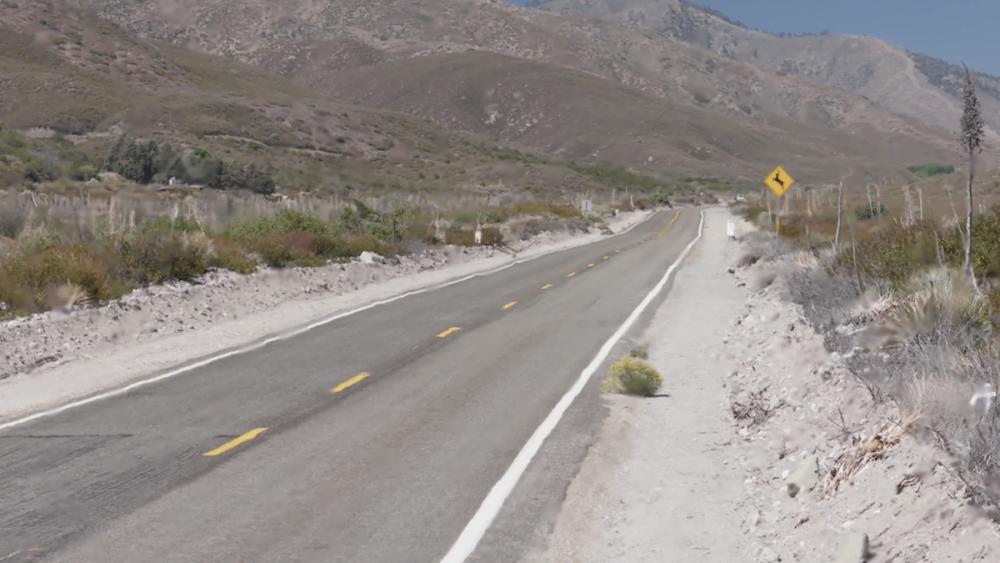
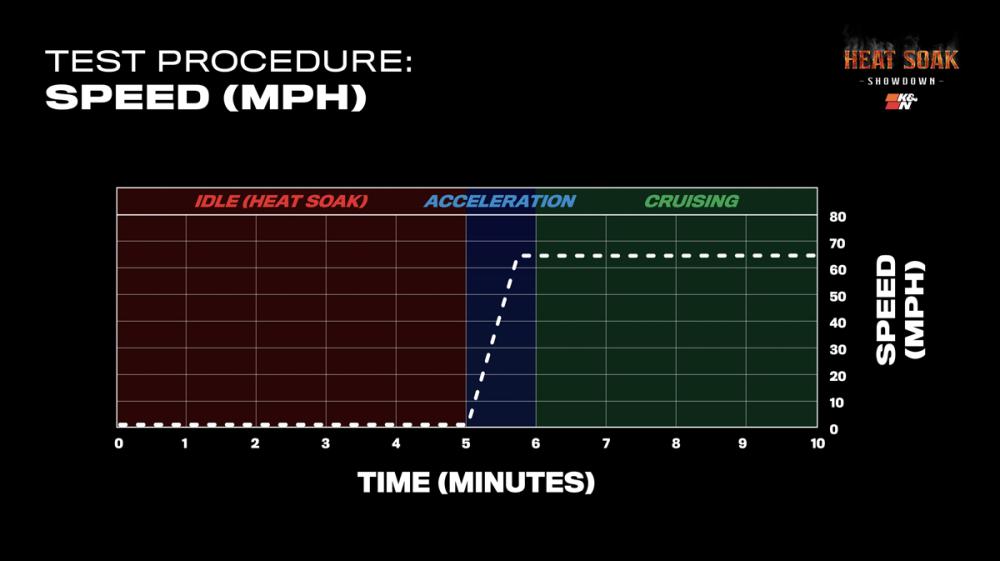
Time for the testing! The first step is to connect our computers to the vehicle to monitor speed and temperature effectively to see how they perform every moment of the test. Once connected, the vehicles engines will be fired up and sit at idle for 5 minutes. This process will show how much heat soak takes place and how quickly that occurs. Then the vehicles will accelerate to 65 miles per hour and drive for another 5 minutes to monitor how quickly temperatures cool down and how that process occurs in each vehicle. Once those tests were completed, we did the exact same process with the K&N intake installed on each vehicle to compare it to the stock setup and see how that change affected the results.
Once all the testing was completed, we headed back to the K&N Development Center to download all the data and review the results…to the air conditioning!

Real-World Results
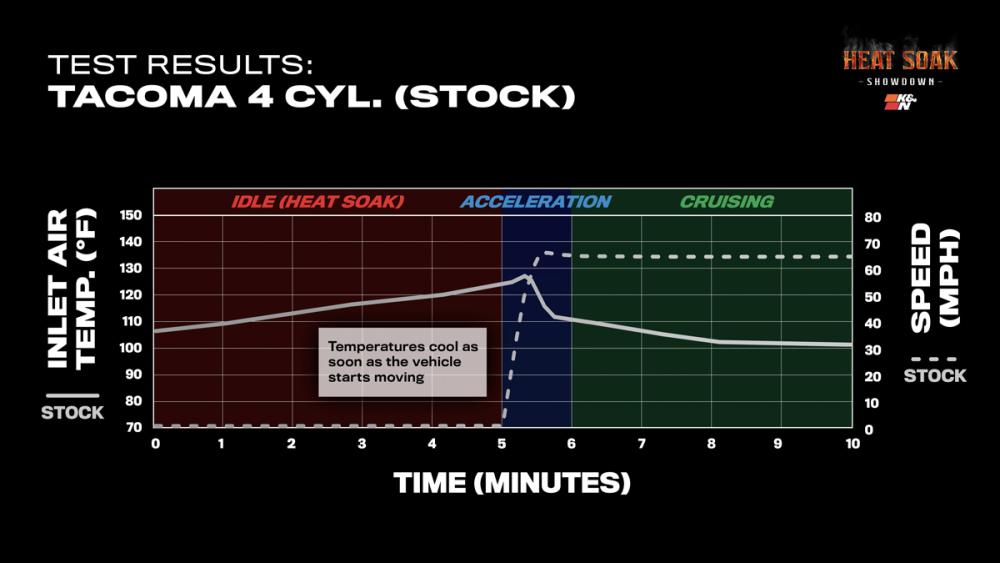
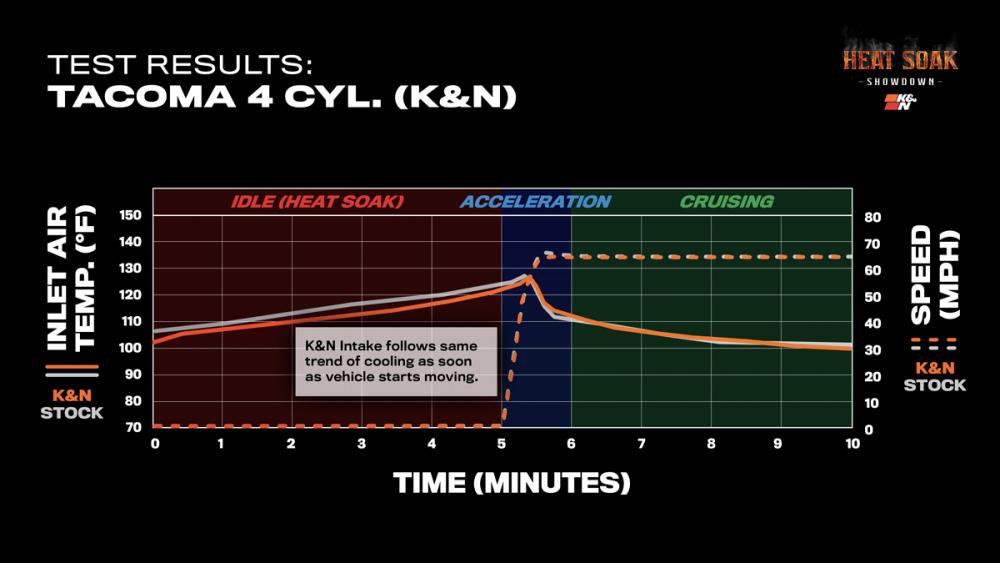
Now that we have some A/C and processed the data from the tests, let’s see how it all stacks up. The Tacoma with the stock intake was first up and clearly shows the phenomenon discussed previously. As the truck idles for the first five minutes of the test, inlet air temperatures continually rise all the way up to the point of acceleration. As soon as 5 minutes is reached and the vehicle starts moving, that fresh outside air comes into the engine bay and immediately starts to cool off the under hood components and the air entering the engine. That cooling continues over the next 5 minutes until the temperature is almost the same as the ambient air temps.
Time to see how the K&N intake compares. With the intake installed, the results are virtually identical and are a few degrees cooler than stock for most of the heat soak phase. The process was exactly the same as expected, heat increases steadily while at idle but drops immediately once moving and continues to drop for the duration of the test. Let’s see how the V8 on the Camaro compares.
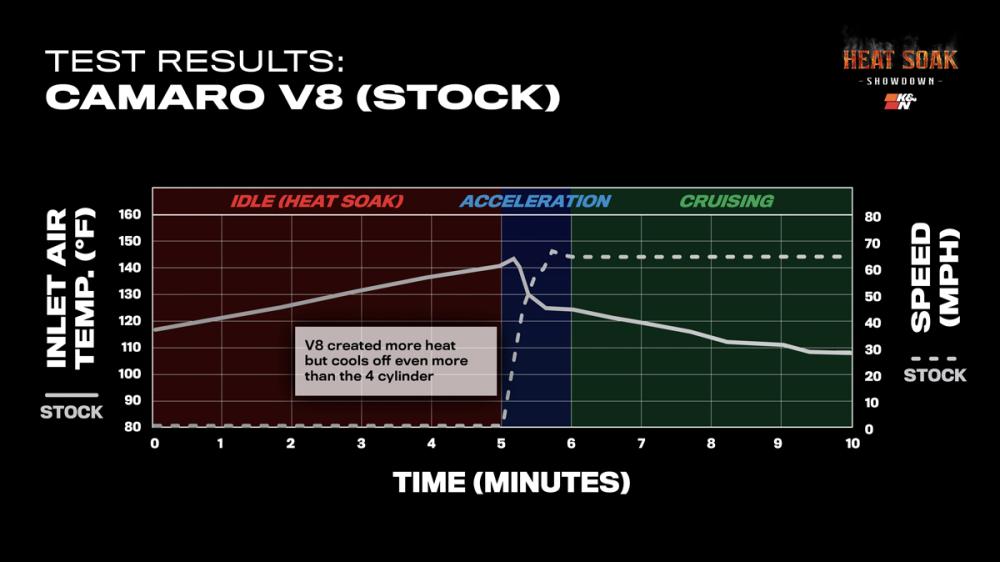
Comparing the data on the Camaro to the Tacoma, the chart looks very similar with a few big distinctions. With the Camaro’s larger engine comes added heat, which creates a more extreme heat soak condition at idle. The temperature starts hotter and increases quicker than it did on the Tacoma. Despite this, the pattern stays the same and cools off immedately once driving. In this case, the temperatures at the end of the test was actually cooler than at the beginning.
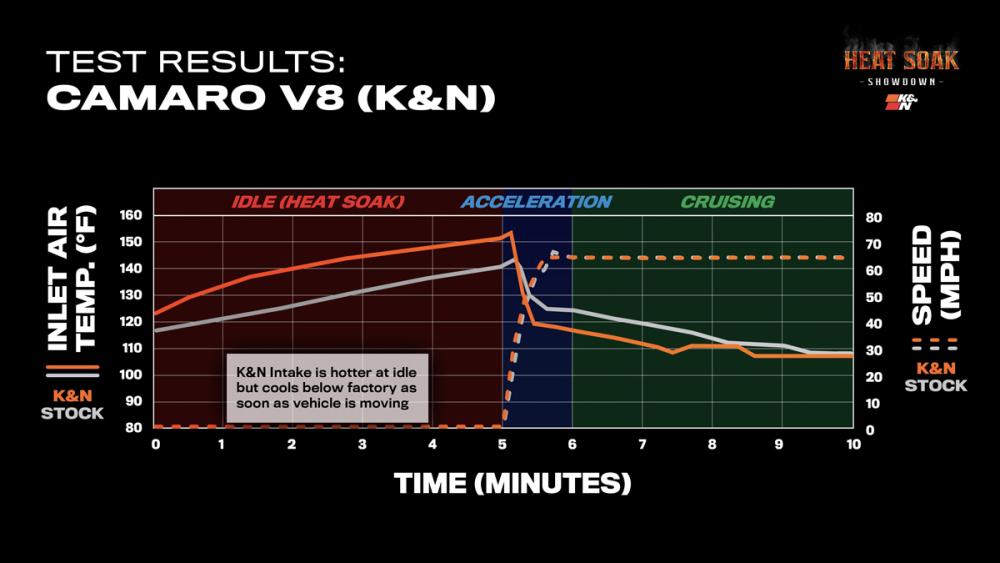
The Camaro with the K&N intake installed, unsurprisingly, follows the same trend as the others. It was clear that the heat soak at idle was a little more extreme with the K&N intake installed, but interestingly, as soon as we started moving, it cooled off even faster than the stock setup. Additionally, it dropped below the stock temps when driving. Interesting for sure, but what does this mean to us all when we’re actually driving?

Real-World Impact
So with all this data, what can we apply to the actual effects of heat soak and how it works in our daily lives? Clearly heat soak is a real thing and happens in every vehicle and with every intake style. From stock, to K&N, to any other setup on any other vehicle, when sitting still, heat will start to build in the engine and create heat. However, there are a number of details to consider before we all start freaking out about how big an impact heat soak makes.
First, our test was demonstrating a very extreme heat soak situation where we idled for 5 minutes in nearly 100° heat. It’s not often we have to sit at idle for 5 minutes in a daily drive. Stop-and-go traffic or a reeeeaaally long stop light are about the only times something like this would take place. Further, when sitting in traffic, a 100 horsepower and 500 horsepower vehicle are both capable of going 5 miles-per-hour without any issues.
Similarly, it’s not every day that we’re driving in extreme ambient temperature conditions. In the summer it’s definitely a bigger issue, but that’s the same for every vehicle on the planet. On the opposite side of the same coin, when it’s 30 degrees outside, everyone gets to enjoy a little more power since the ambient temperature helps keep temps down and cools the engine even faster once the vehicle starts moving.
Another critical aspect of heat soak that needs to be considered is the impact temperature variance makes in horsepower. According to our thermodynamics expert Bisi, every 10 degree increase in inlet air temperature translates to about 1% horsepower loss. Alternatively, every 10 degree decrease in temperature creates about a 1% increase in power. So let’s look at the V8 Camaro for reference as this is a fairly high horsepower vehicle coming in at about 350 wheel horsepower. If the air inlet temperatures rise 10 degrees due to heat soak, we’re looking at roughly 1% power loss, or a 3.5 horsepower decrease. I don’t know about you, but our butt dyno isn’t finely tuned enough to even notice that difference.
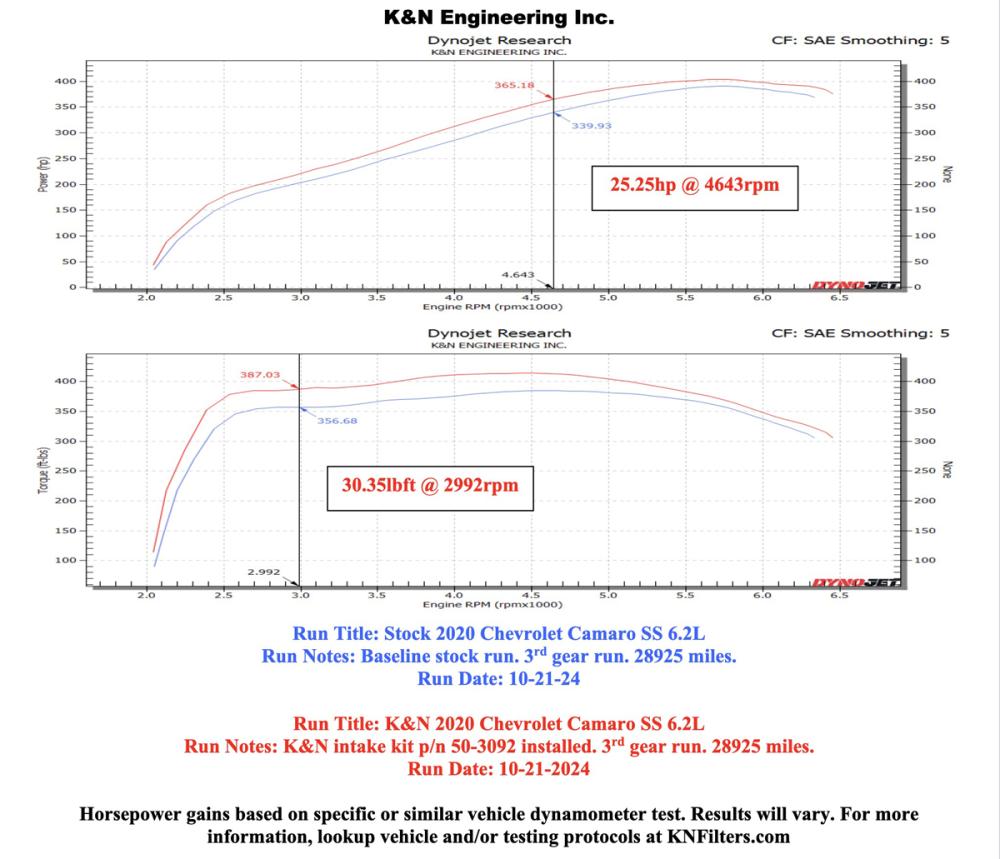
Let’s not forget that the K&N intake installed on the Camaro saw a 25 horsepower gain over stock on the dyno. So even if in some extreme situation the K&N intake heat soaks 20 degrees more than the stock setup, it would still be 18 horsepower better than stock (350 base HP, minus 7(2%) from heat, plus 25 from K&N awesomeness).
So to recap, the biggest issues related to heat soak are ambient air temperature and driving speed. The type of vehicle and type of intake are not even variables worth worrying about. Sounds to us like all this concern over heat soak isn’t worth the time we’re putting into it.
The biggest aspect of heat soak and power loss due to temperature increases really focuses around airflow and getting that fresh cool outside air into the engine bay as quickly as possible. Thankfully, that’s where K&N has been an expert for over 55 years. Everything we do is about airflow – more air, smoother air, and cooler air. That’s where the power gains are really seen, and where K&N intakes are built to perform. If you need any reminder of that fact, check out our horsepower shootout video where we compared the performance of multiple different intakes and saw that K&N outperforms the competition in airflow, dyno horsepower gains, and real-world track times.
You can see the shootout video here or if you’re ready to give your engine real airflow and a power boost, find the intake for your vehicle at knfilters.com.